em
Projetos de Satélite
A curated path through the satellite work: start with reception hardware, follow the signal-processing experiments, and continue into complete weather-satellite decoding systems.
GOES Satellite Hunt
The strongest place to start. This book-length guide documents the full GOES-13 LRIT receive chain and the engineering lessons that later became Open Satellite Project.
NOAA APT and Meteor LRPT
Accessible VHF projects for building the receiving station and learning the signal path.
- QFH antenna and first NOAA reception Build the antenna, track a pass, and receive the first weather image.
- Recording NOAA APT with GQRX and RTL-SDR Configure the Linux software stack and preserve a pass for offline decoding.
- 137 MHz band-pass filter Design, build, and measure a dedicated filter for NOAA and Meteor reception.
GOES field notes
Experiments and milestones that continued after the original GOES-13 receive chain.
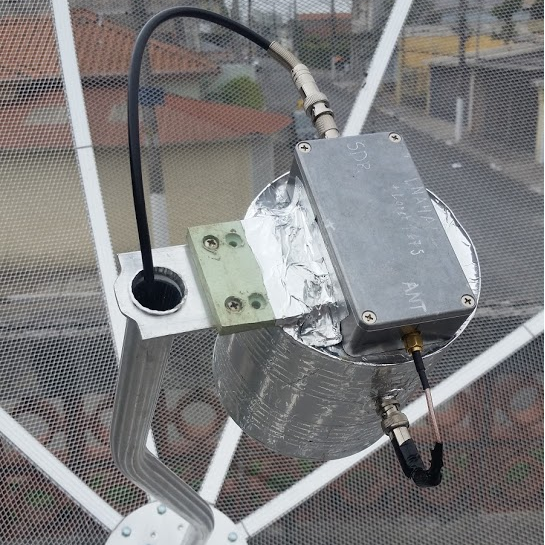
- A new 2.2 m dish Hardware expansion for stronger L-band reception and future signals.
- GOES-16 in the house Early reception and reverse engineering of the next GOES generation.
- GOES-16 test week Preparing the station and decoder for the experimental HRIT broadcast.
- GOES-16 test week results Decoded ABI products, false-color imagery, and lessons from the live test.
- LNA tests for HRIT and LRIT Practical gain and noise comparisons for the satellite receive chain.
- GOES GRB first light The jump to the high-rate GOES Rebroadcast service and its first decoded products.
Related resources
Original articles, reusable recordings, and the software created from the research.
The five-part GOES blog series
Read the original chronological posts that were reorganized and expanded into GOES Satellite Hunt.
Open part oneGOES baseband recordings
Use real LRIT, HRIT, telemetry, EMWIN, and DCPR captures to test your own signal-processing code.
Browse the recordings