on
My Tesla Coils
Resonant power, FPGA-controlled sparks, and a little music.
A workshop archive of SSTCs, DRSSTCs, musical interrupters, experimental feedback circuits, and the long evolution of ZARC—from a 600 W prototype to a four-channel FPGA-controlled machine.
- 13
- documented builds
- 16
- recordings
- 2011–2012
- archive period

An archive of sparks, failures, and working hardware
These are the builds that survived well enough to document. Together they trace experiments with switching devices, feedback, tuning, audio modulation, mechanical construction, and FPGA control.
Dates refer to video uploads rather than exact build dates. Recording and upload were usually close together.
Major builds
The larger milestones, from the portable ZINC coil back through ZARC's final enclosure, tuning, MIDI controller, and early full-body tests.
ZINC SSTC
Audio-modulated portable coil
The last Tesla coil I built was a compact SSTC driven by two IRFP250N MOSFETs and a protoboard GDT driver. I designed it to travel, so I could demonstrate musical arcs away from the workshop using ZARC's audio interrupter.

Driverless SSTC
Direct current-transformer feedback
An experimental half-wave, driverless SSTC of my own design. A current transformer on the secondary feeds the MOSFET gates directly. I never optimized the circuit, but the feedback scheme worked.


ZARC with FPGA MIDI Interrupter
Four channels on 220 VAC mains
ZARC's final configuration paired a four-channel polyphonic FPGA MIDI interrupter with the controller in the coil's base. The limiter was set to 400 A; after detuning the coil slightly, measured primary current stayed below 320 A.


ZARC — Tuned Base
The final 1 kW mechanical build
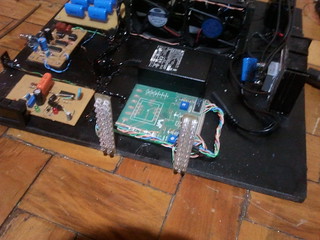
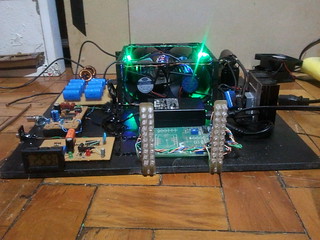
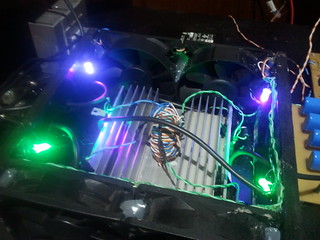
I rebuilt ZARC's base and refined the tuning into what became the final hardware setup—about 1 kW input, doubled 110 VAC for roughly 320 VDC on the bus, and 300 A peak through an IRG4PC50UD full bridge. It remains one of my favorite electrical engineering projects.


ZARC — First Full-Body Test
Final enclosure, early tuning
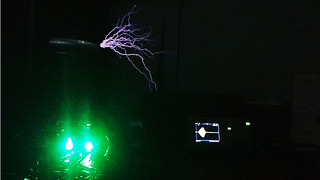
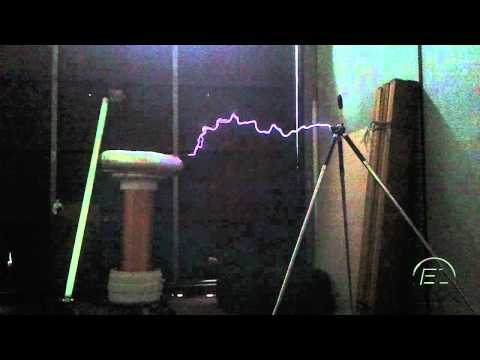
ZARC reached its final physical form before its final tuning pass. The interrupter was still the rough early version, but the system produced nearly 70 cm arcs with much better stability.

Bench experiments
Smaller coils and topology tests that fed the main builds: continuous-wave SSTCs, early DRSSTCs, audio modulation, and a flyback-powered spark-gap coil.
Musical DRSSTC
The first reliably working audio-modulated DRSSTC in the ZARC line. Earlier attempts mostly ended in explosions; this prototype finally turned the interrupter into music and stable arcs.

Mini DRSSTC
A compact DRSSTC experiment from the same development period, built to explore the topology at a smaller scale.

1.5 MHz Micro SSTC
A continuous-wave SSTC running at 1.5 MHz from a full bridge of IRF740 MOSFETs—an intentionally aggressive switching frequency for that device.

Medium SSTC 3
Audio-modulated interrupter
This build reused the secondary from my other medium SSTCs and first DRSSTC, then changed the top load and added audio modulation.

First Working DRSSTC
My first working DRSSTC used primary current-transformer feedback and a half bridge of STGW30NC60WD IGBTs. Doubled rectified 127 VAC supplied roughly 300 VDC to the main bus.

Medium Half-Wave CW SSTC
A medium 30 × 10 cm secondary driven in continuous-wave mode by two IRFP260N MOSFETs from an unfiltered half-wave rectified supply.
ZVS Spark-Gap Tesla Coil
Flyback-powered experiment
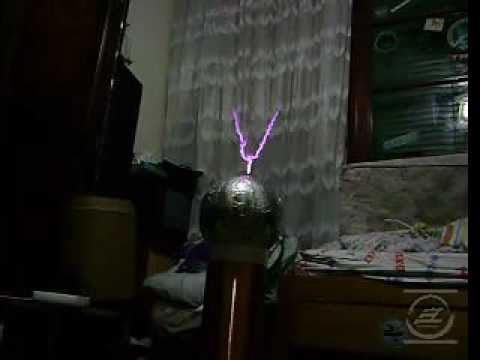
A spark-gap coil powered by a flyback transformer on a Mazzilli ZVS driver with two IRFP250N MOSFETs at 30 VDC and a 1 nF, 40 kV capacitor bank.

ZARC — 600 W Prototype
The early ZARC prototype produced nearly 50 cm arcs at 600 W. It introduced IRG4PC50U IGBTs with reverse ultrafast diodes to damp reverse voltage peaks.
